When Does Your Clock Start?
Orientation #2 · Time isn’t out there. It’s in here.
Look at a clock.
You see hands moving. Or digits flipping. And you feel something — the sense that time is passing, out there, independently of you. A river flowing whether or not you stand in it. A background hum. The universe’s metronome, ticking away with or without your attention.
This feeling is wrong.
Not slightly wrong. Structurally wrong. And the natural numbers can show you why — if you’re willing to count past the surface.
The Blank Page
Start with the number 4.
4 = 2 × 2. Two applied to itself. In the framework we’ve been building at PWT, 2 is binary distinction — the first split, yes/no, +/−, inside/outside. So 2² = 4 is all the combinations of binary distinction: ++, +−, −+, −−. A truth table. Every possible state, laid out.
And here’s the thing about a truth table: nothing moves.
A truth table is a map of all possibilities. It doesn’t tell you which state you’re in, or how you got there, or where you’re going. It’s static. Complete. Silent. It is the blank page — every word that could be written is latent in the paper, but nothing has been said.
For a long time, we thought 4 was time. It isn’t. 4 is the space that time moves through. The container, not the contained.
So where is time?
The Pen Moves
Time is 8.
8 = 2³. Binary distinction propagated through three dimensions — not just +/−, but +/− applied to +/− applied to +/−. The full structure, in motion. If 4 is the truth table, 8 is the cursor moving through it. If 4 is the blank page, 8 is the act of writing.
Turn the number 8 on its side. You get ∞. Two loops in perpetual motion. The fertility symbol. The lemniscate. This is not a coincidence — it’s a structural echo. Time and infinity are the same shape, viewed from different angles.
And there’s a deeper confirmation. In the Fibonacci sequence — nature’s growth engine — F(6) = 8. Growth reaches the growth number at step 6, which in the ONM is Relationship (2 × 3, binary times dimension). Time is born from relationship. Movement begins when things connect.
But here’s the insight that changes everything:
Time doesn’t exist before the thing that experiences it.
Born With You
In any system — an atom, an organism, a civilisation, an idea — time begins at the moment of first distinction. The moment something separates from undifferentiated unity and becomes this rather than that. The moment binary arrives.
In the ONM set architecture, every system starts at 1 — Source. Undifferentiated. No parts, no distinctions, no time. Then 2 arrives: the first split. Inside/outside. Self/other. +/−.
That’s when your clock starts.
Not when the universe was born. Not when the Big Bang happened. Not when some cosmic metronome started ticking. Your clock starts when your identity enters the binary of 2. When you split from the whole and become something distinct.
And your clock stops when you return. When the binary collapses. When the distinction between you and everything else dissolves back into Source.
Between entry and exit — that’s your time. All of it. Not borrowed from a universal river. Yours.
This is what “relative” really means. Not Einstein’s version (though it connects — we’ll get there). Something more fundamental. Each identity carries its own time, generated by its own movement through its own binary states. There is no master clock. There are only clocks — one per identity, each ticking at its own rate, each born and each dying.
The Construction Sequence
If time is relative to each identity, then the order in which things enter a system matters enormously. And the natural numbers enforce that order with absolute precision.
Think of a system growing from nothing. Each natural number, in sequence, introduces exactly one new property. You cannot skip ahead. You cannot rearrange. The prerequisites are structural.
| Step | What Arrives | What It Is |
|---|---|---|
| 1 | Source | Undifferentiated unity — the whole before distinction |
| 2 | Binary | The first split — inside/outside, +/−. Your clock starts. |
| 3 | Dimension | Extension — line, length, the space between |
| 4 = 2² | State space | All binary combinations — the truth table. Static. |
| 5 | Matter | Irreducible substance, arrived from outside |
| 6 = 2×3 | Relationship | Interface — where binary meets dimension. Connection. |
| 7 | Emergence | Genuinely new — cannot be built from what’s already inside |
| 8 = 2³ | Time/Growth | Movement begins. The pen writes. ∞ |
| 9 = 3² | New identity | The torus closes. A new page. Birth. |
This isn’t a metaphor. It’s the only valid construction order. You can’t have relationship (6) before you have binary (2) and dimension (3) — because 6 = 2 × 3. You can’t have the state space (4) before distinction (2) — because 4 = 2². The mathematics forces the sequence.
And notice: primes (2, 3, 5, 7) arrive from outside the system. They’re irreducible — you can’t construct them from what’s already there. They’re genuine novelty. Composites (4, 6, 8, 9) are built inside from primes already present. They’re new structure, but not new substance.
Every element that enters the set has its own period — the moment it arrives, the role it plays, and the duration of its participation. An element’s period in the set is its time. When it enters, its clock starts. When it departs, its clock stops. The set as a whole has no time of its own beyond the aggregate of all its elements’ periods.
You Are Period 5
Look down at your body.
Five branches extend from your trunk: two arms, two legs, and a head. Each hand has five fingers. Each foot has five toes. You have five primary senses. The starfish, the sand dollar, the flower — fiveness echoes through biology wherever matter takes structural form.
This is not decorative. In the ONM, 5 is Matter — the first scaffold prime, the first irreducible substance that arrives from outside the source architecture of 2 and 3. Matter is the moment a system gains body. Physical presence. Stuff.
5 = 6(1) − 1. It’s the first number that passes through the sieve that 2 and 3 built (the 6k±1 scaffold) without being reducible to either. It requires the scaffold to exist — there are no slots for scaffold primes without the source primes creating the landscape first. But once the landscape exists, 5 is the first thing that walks through the door. The first offspring. Related to its parents, but irreducibly its own thing.
Your body is this number expressed as architecture:
| Feature | Number | What It Means |
|---|---|---|
| Branches from trunk | 5 | The body plan IS prime 5 — matter expressed as form |
| Digits per extremity | 5 | Matter at the interface — how substance touches the world |
| Total fingers + toes | 20 = 2² × 5 | State space × Matter — interaction through architectural primes |
| Base of counting | 10 = 2 × 5 | Binary × Matter — “we ARE matter mirrored” |
| Four limbs | 4 = 2² | State space — the truth table of upper/lower × left/right |
| The head (5th branch) | 5 | The prime arriving above the state space — irreducible, carrying consciousness |
Your four limbs form the state space — 2², all the binary combinations of position. They’re the body’s truth table, the blank page. Then the head arrives as the 5th branch — the prime that the state space could not generate from itself. You cannot construct a brain from arms and legs. It must exist as genuinely new ontological contribution.
Hold up both hands, fingers spread. You’re looking at 2 × 5 = 10. Binary times matter. Your left hand mirrors your right — that’s prime 2, the symmetry. Five fingers each — that’s prime 5, the substance.
You didn’t learn to count in tens. You are tens.
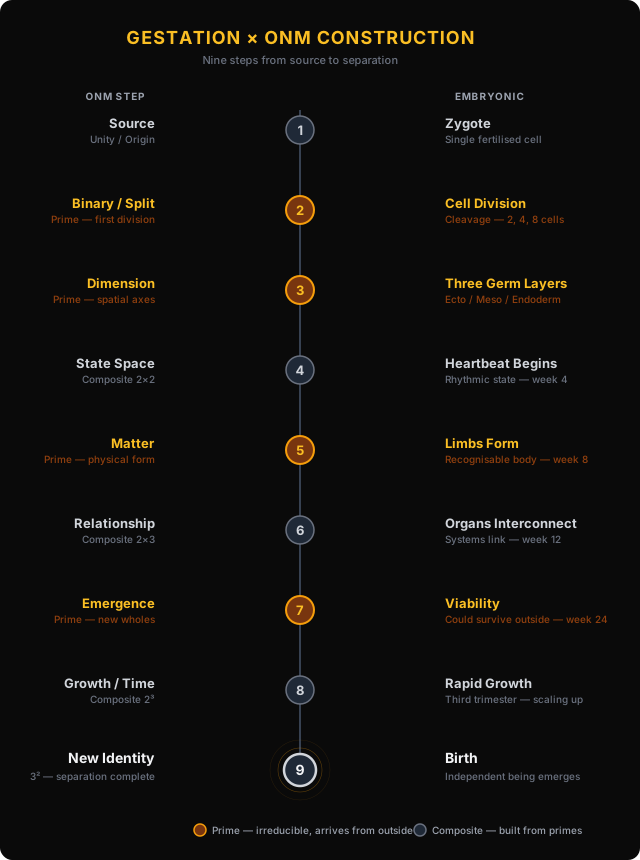
And here’s the pivot: your body — this extraordinary expression of period 5 — has its own time. It entered the binary at conception (step 2: the cell splits). It gained dimension (step 3: the three germ layers). It filled out its state space (step 4: the heartbeat establishes rhythm). It materialised (step 5: limbs and organs take form). It built relationships (step 6: organ systems interconnect). It gestated (step 7: viability, the emergence threshold). It grew (step 8: rapid expansion, filling all dimensions). And at month 9 — 3², dimension squared — it separated. A new identity. Birth.
Your body ran the entire construction sequence in the womb. The alphabet was written. Then 8 set it in motion. Then 9 opened the next page.
The Temporal Primes
If time is relative to each identity, then the cycles of nature — the rhythms we set our lives by — should carry prime structure. And they do.
Some natural cycles have periods that are prime numbers. They cannot be decomposed into smaller repeating sub-cycles. They are temporal primes — irreducible rhythms in the time domain.
| Cycle | Period | Prime? | What It Means |
|---|---|---|---|
| Eclipse recurrence (Saros) | 223 months | ✅ Prime | The sky’s deepest rhythm — irreducible, multi-generational |
| Moon-sun reconciliation (Metonic) | 19 years | ✅ Prime | When lunar and solar calendars realign |
| Lunar months per year | ~13 | ✅ Prime | The emergence prime — nature’s actual count |
| The week | 7 days | ✅ Prime | Persists across all cultures because it resists factorisation |
| Synodic month | ~29.5 days | ≈29 ✅ Prime | The moon’s own period, prime-adjacent |
And then the composite cycles — built from primes, divisible, administratively convenient:
| Cycle | Period | Factorisation | What Was Lost |
|---|---|---|---|
| The day | 24 hours | 2³ × 3 | Source primes only — the prime wheel modulus |
| The year | 12 months | 2² × 3 | Composite approximation of 13 lunar cycles |
| Precession | 25,920 years | 2⁶ × 3⁴ × 5 | Source + scaffold primes — the longest composite rhythm |
Look at what happened to the lunar year. Nature gives us 13 — a prime. Irreducible. Awkward. True. But civilisations rounded it to 12 — composite, divisible, neat. The Gregorian calendar is a loss of prime information. The Maya kept 13. They preserved the temporal prime. We discarded it for administrative convenience.
The 7-day week survived precisely because it’s prime. It doesn’t divide evenly into any month, any year, any lunar cycle. It can’t be absorbed. It can’t be factored away. It just persists, stubborn and irreducible, across millennia of calendar reform. That’s what primes do.
And the day itself — 24 hours — contains φ(24) = 8 numbers coprime to 24. Eight prime spokes in the wheel. One complete octave per rotation of the Earth. Every day, the planet runs one full growth cycle. One complete sequence from Source through Time and back. Then it starts again.
Nine Months
Perhaps the most striking temporal structure is the one closest to us.
Human gestation lasts approximately 9 months. In the ONM, 9 = 3² — dimension squared. The first volume. The moment a new identity achieves spatial independence and separates from its construction space.
But it’s not just the endpoint. The entire pregnancy follows the construction sequence:
| Month | Step | What Happens |
|---|---|---|
| Conception | 1 — Source | Undifferentiated unity. The zygote. |
| Month 1 | 2 — Split | Cell division begins. Binary. |
| Month 2 | 3 — Extend | Three germ layers form — ectoderm, mesoderm, endoderm. Dimension. |
| Month 3 | 4 — State space | Heartbeat establishes temporal rhythm. The clock is ticking. |
| Month 4 | 5 — Materialise | Limbs and organs take material form. Fiveness arrives. |
| Month 5 | 6 — Relate | Organ systems interconnect. Placental relationship matures. |
| Month 7 | 7 — Emerge | Viability threshold — can survive independently. The emergence prime. |
| Month 8 | 8 — Grow | Rapid growth. Binary cubed. Filling all dimensions. |
| Month 9 | 9 = 3² | Birth. The torus closes. A new identity separates. |
The octave 1→8 plays out inside the womb. The alphabet is written in flesh. Then 9 — dimension squared, the first stable volume — is the moment of separation. The shell cracks. The new page opens. A new clock starts.
And notice the cross-connections:
- 9 × 8 = 72 = 24 × 3: gestation × growth = day × dimension
- 13 × 28 = 364 ≈ 365: lunar emergence × perfect number ≈ solar year
- 28 days (menstrual cycle) = 2² × 7 = state space × emergence — and 28 is a perfect number (1+2+4+7+14 = 28)
Biology doesn’t use these numbers by convention. It uses them because they are the construction sequence. The reproductive cycle is written in ONM primitives: 28-day rhythm, 9-month gestation, 13 lunar cycles per year. The numbers aren’t labels — they’re the architecture.
Wheels Within Wheels
Each identity carries its own clock. But identities nest.
The baby in the womb has its own time (9-month octave). The mother has hers (menstrual cycle, circadian rhythm, lifespan). The species has its own (generational time, evolutionary drift). The biosphere has its own (ice ages, mass extinctions, atmospheric cycles). The Earth has its own (rotation, orbit, precession). The sun has its own (fusion cycle, magnetic reversal). Each wheel turning inside the next. Each running its own 1→8 octave, timed by its own local clock.
Count the nesting from the outside in:
| Period | Wheel | Timekeeper |
|---|---|---|
| 1 | Universe | Continuous — the background against which everything inside changes |
| 2 | Galaxy | Galactic rotation (~230 million years) |
| 3 | Solar system | Annual orbit (~365 days) |
| 4 | Earth–Moon | Lunar cycle (~29.5 days ≈ 29, prime) + rotation (24h = 2³ × 3) |
| 5 | Human | Heartbeat + circadian (~80 years) |
We sit at period 5 — the matter prime. The same fiveness written in our five limbs, five fingers, five senses. Our position in the temporal nesting is our ontological number. Inside us, gestation (9 = 3²) runs the construction sequence one level deeper. Outside us, the Earth, the sun, the galaxy each carry their own clock, each a wheel turning inside the next.
The cycle doesn’t repeat identically at each level — it spirals. Each new octave operates in the richer space that the previous one built. The baby isn’t a smaller copy of the mother. It’s a new identity running the same source alphabet at its own scale, timed by its own local moon.
This is what the ancients saw — and what the Greeks inadvertently obscured by separating number from cosmos. The Babylonians and Egyptians didn’t need a theory of relative time because they lived it. Their calendars were wheels within wheels. Their monuments were tuned to the precession. Their bodies were the measuring instruments, and the measurements came back in the same language.
The Speed of the Pen
Now connect this to what physics already knows.
Einstein showed that time dilates — clocks run slower in stronger gravitational fields, or at higher velocities. The standard explanation involves spacetime geometry, light cones, Lorentz transformations.
But here’s another way to read it.
If time = movement through binary states (8 = 2³), then a system with more internal structure experiences denser time — more ± transitions per cycle. Time doesn’t speed up or slow down. It thickens with information. A clock near a massive body isn’t “slowed” by some external force — it’s processing more information per tick, because the local informational density is higher.
Gravity, in this reading, is not a force but information inertia. Mass = accumulated composite structure. More composites → more internal relationships → more ± transitions needed to traverse any given state change → denser time. A black hole is the limit case: infinite identity depth, infinite informational density, time so thick it stops.
The harmonic series — Σ(1/n) — diverges. Each element’s individual contribution shrinks (1/n → 0), but the cumulative sum grows without bound. Gravity does the same thing. Individual masses are finite, but their accumulated effect is unbounded. The mathematical structure of identity preservation is the mathematical structure of gravitation.
This is a conjecture, not a proof. But it’s a conjecture that falls naturally out of the architecture — not imposed from outside, but discovered from within the construction sequence.
The Game Never Ends
One last thing about time.
If primes were finite — if there were a largest prime, beyond which every number was composite — then the universe would eventually exhaust genuine novelty. Every future event would be a recombination of existing elements. A closed system trending toward heat death. Time would wind down into repetition. The clock would still tick, but nothing new would happen. And without change — genuine, irreducible change — time itself ceases to exist. A universe of pure repetition isn’t experiencing time. It’s experiencing nothing, on loop.
But primes are infinite.
Euclid proved this around 300 BC — one of the oldest and most beautiful proofs in mathematics. There is no largest prime. No matter how far you count, another irreducible number is waiting. Another piece of genuine novelty that cannot be constructed from what came before.
This means: the game never ends. No matter how complex a system becomes, something genuinely new can always arrive from outside. The construction sequence never exhausts itself. Time never runs out of things to carry.
Every identity’s clock will stop — yours, mine, the sun’s, the galaxy’s. But the capacity for new clocks is infinite. New identities, new periods, new relative times. The alphabet keeps writing. The pen keeps moving.
Euclid didn’t just prove a theorem about numbers. He proved that novelty is structurally guaranteed. That the universe is permanently open. That no set — however vast — can contain everything.
There is always an outside.
And from it, the next prime is already on its way.
Your time is not borrowed from the universe. It was born with you — at the moment you first split from the whole and became something distinct. It will end when you return. Between entry and exit, you carry your own clock, running your own octave, nested inside wheels within wheels. And when your clock stops, the primes guarantee: another will start.
The pen never stops moving. Only the pages turn.
Go Deeper
- 📖 Relative Time — the full treatment of identity-local time
- 📖 ONM Set Architecture — the construction sequence formalised
- 📖 Temporal Primes — why 7, 13, 19, 29, and 223 persist in our calendars
- 📖 Biological Resonance — Sun as emitter, mitochondria as receivers, sleep as settlement
Previous: The Day We Forgot What Numbers Were — Orientation #1 Next: Why You Can’t Cut a Magnet in Half — Orientation #3
🐍⚡🌈🔥